
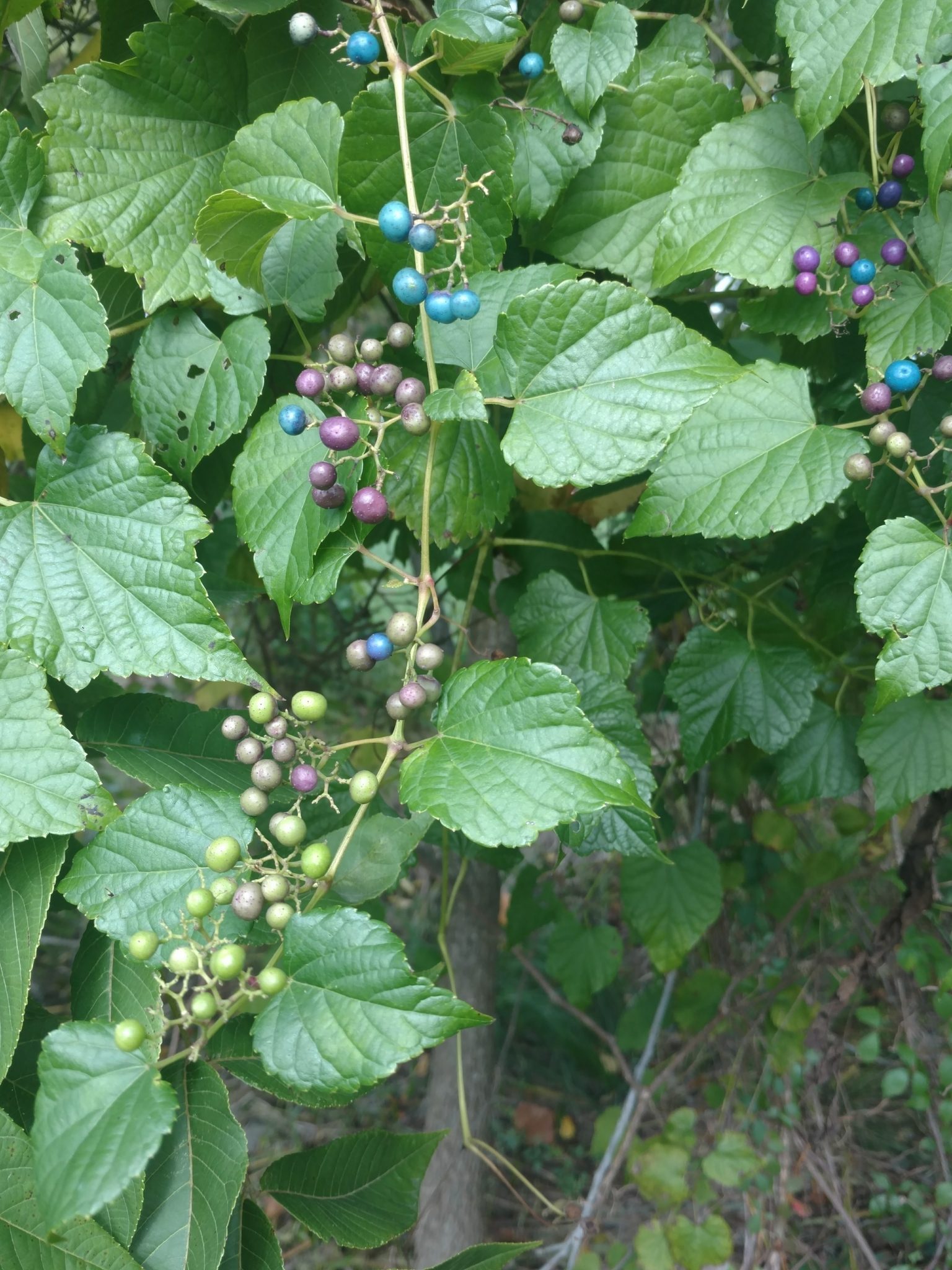
A number of years ago, while walking in the woods, I came upon a beautiful vine with almost incandescent blue and purple berries and lovely forked leaves resembling grape leaves. I plucked a few sprigs and put them in a vase to admire at home.
While I had always been an “observe and enjoy” rather than an “observe and identify” outdoor enthusiast, after I became a Fairfax Master Naturalist in 2017, I became obsessed with the iNaturalist app, which lets you take a picture on your phone and identify flora and fauna. When I came across those blue and purple berries again, I used iNaturalist and discovered they had a wonderfully apt name: porcelain berry. What a perfect name, I thought, for these beautifully-hued and seemingly delicate plants.
Fast forward to a Fairfax ReLeaf invasive removal and tree planting event with volunteers from my faith organization. I learned to my dismay that this “delicate” vine I had so admired was wreaking havoc in Fairfax County. It creeps up trees into the canopy and shades them out, weighing trees down, and often breaking branches. According to the VA Department of Natural Heritage, porcelain berry is rated “highly invasive” and “is a serious threat to native plant communities.”
I learned to my dismay that this “delicate” vine I had so admired was wreaking havoc in Fairfax County. It creeps up trees into the canopy and shades them out, weighing trees down, and often breaking branches.
While its greenery often blends in with bush and tree foliage in the summer, in the winter months you can see huge swaths of its brown vines draped over bushes and trees like a thatched roof. Once you see the damage it is causing, it is hard to “unsee” it: in our parks, along our roadways, and this year, in my yard.
I live on a wooded lot with tall oaks, tulip poplars, and other native trees. From seeds brought by birds, or perhaps due to some landscaping my neighbors engaged in this past year, porcelain berry has invaded, wrapping its beautiful but deadly tendrils around my trees and bushes. So now it is personal!
I still admire those porcelain-like berries, but I have come to think of the porcelain berry vine as the Ted Bundy of the plant world— attractive and alluring, but deadly. It must be stopped.
Wendy N. Cohen
PORCELAIN BERRY ERADICATION TIPS

The best way to get rid of porcelain berry vines is to dig out the taproot. Alternatively, you can cut a swatch out at the base of the tree, and the vines above will die off. Herbicide is another option. Removing the vines before they berry will reduce regrowth—and early July is precisely when they start to get their berries. But if you don’t have time or the inclination to remove the vines, and the berries have emerged, do remove all the berries from the vine and place them in the trash.  Removing berries from porcelain berry vines can help reduce regrowth and prevent the spread of seeds. It is important to place cut vines in the trash, not the compost heap, to avoid re-emergence of this killer plant.
10 Steps You Can Take to Support Local Biodiversity – Advice from Dr. Doug Tallamy
Posted: April 27, 2021
Center for Pollinator Research IPE Student Fellow Staci Cibotti outlines ten of Dr. Doug Tallamy’s recommendations for improving local biodiversity.
Photo by Doug Tallamy
Widely reported declines of insect abundance and diversity at global scales have left many wondering what personal actions they can take to restore local insect populations and bring balance to the ecosystems those insects serve. Dr. Doug Tallamy, a Professor at the University of Delaware, is the author of the New York Times best seller, ‘Nature’s Best Hope,’ which outlines approaches that homeowners and landowners can adopt to provide local refuge to imperiled insect and bird populations. Earlier this month, Dr. Tallamy delivered a seminar to the Penn State Entomology Department, where he outlined 10 basic steps to combat insect declines and support local biodiversity.
Step 1: Reduce the size of your lawn
Americans love green lawns. It’s estimated that 40 million acres, or roughly 2% of the landmass of the United States, is planted with turfgrass.1 While turfgrass is pleasant to walk on, it offers no ecological benefits. Dr. Tallamy recommends reducing your lawn size by half, and planting the remainder with native species.
Step 2: Remove non-native plant species and replace them with natives
Not only do non-native species offer little to no benefits for local wildlife, they can also escape cultivation and invade local ecosystems; preventing the growth of native species and further contributing to declines in insect abundance and biodiversity.2
Native plantings do not necessarily need to look wild or unkempt; it is possible to have well-manicured yards and gardens cultivated with native plant species rather than non-natives. While you may not want to replace all of the non-native ornamentals in your yard, Dr. Tallamy recommends reducing as much as possible. He advises having no more than 30% of the yard dedicated to non-native species.
Step 3: Prioritize planting keystone genera
Some genera of native plants are called keystone genera, meaning that they are essential for helping support local ecosystems. Without these genera, local food webs can collapse. Dr. Tallamy’s lab researches plants that serve as keystone genera here in the eastern U.S., which include: oaks, cherries, willows, birches, cottonwood elms, goldenrods, asters, and sunflowers.
There are many cultivated, non-native varieties of the plants referenced above which do not perform as well as native, locally adapted cultivars. When shopping for plants, be sure to buy species or varieties that are native to your region. The closer to home the seeds and/or cuttings were collected, the better!
Step 4: Design plantings aimed at supporting native bees and caterpillars
Native bees and caterpillars are crucial to the survival of local food webs. Native bees are generally the most effective pollinators of native plants, and adequate pollination is essential for ensuring the plant will set fruit and/or seed. These native fruits and seeds provide valuable food sources for many wildlife species. Additionally, caterpillars are important food sources for wildlife, particularly for young birds. Research from Dr. Tallamy’s lab indicates that for 80% of bird families, caterpillars are the dominate component of nestling diets. In fact, Dr. Tallamy found that it can take between 6,000 to 9,000 caterpillars to rear just a single clutch of chickadees!
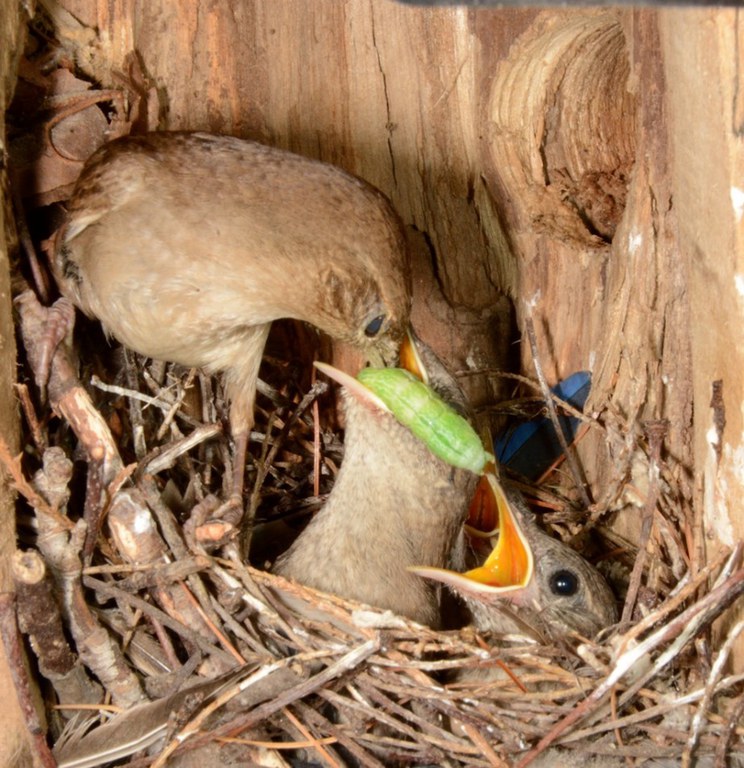
Photo by Dr. Doug Tallamy
Step 5: Plant with specialist species in mind
Related to Step 4, many native bees and caterpillar species are specialists, meaning that they will only feed on certain plant genera. If you want to attract these species to your yard, you’ll need to figure out what plants they specialize on. For example, if you’re interested in helping to support monarch butterfly populations, one of the best things you can do is to plant milkweed in your yard, as it is the only plant the species will feed on during its larval form.
Step 6: Think you’ve planted enough? Try planting some more!
Seriously, the more the better! Try to maximize the ecological potential of your property. It doesn’t matter if you live on a quarter acre lot in the heart of a major city, a multiacre property in the country, or something in between. Whatever amount of land you’re able to transform in favor of local biodiversity can and will make a difference. If you don’t own property, consider helping a friend or relative transform theirs!
Step 7: Reduce light pollution
Artificial light can disrupt insect navigation, resulting in confusion and disorientation. This can make it more difficult for nocturnal insects to find mates,or locate essential breeding habitats and food resources.3 Insects attracted to outdoor lights often get caught swirling around them, making them easy targets for predators or causing them to die from exhaustion.
Luckily there are some simple steps you can take to reduce light pollution around your home. Dr. Tallamy recommends installing motion activated lights and replacing white light blubs with less disorienting yellow bulbs.
Step 8: Provide places for insects to nest and overwinter
Next fall, when the leaves begin to blanket your yard, don’t reach for the rake! That ground cover likely contains insects that dropped from trees to pupate in the soil or duff, and the leaves provide them with protection. Fallen leaves can also serve as valuable nesting or bedding material for wildlife, and will act as a natural mulch, suppressing weeds and restoring nutrients to the soil as they decompose.
Dr. Tallamy also recommends layering low growing or annual plant species in the understory of trees and shrubs, which will provide nice coverage while still allowing access to the dirt – ideal for caterpillars looking for a safe location to pupate, or solitary ground-nesting bees looking for a nest site!
Step 9: Avoid using pesticides and fertilizers
Fungicides, insecticides, herbicides, rodenticides, and synthetic fertilizers all introduce additional chemicals into your garden habitat that insects are much better off without. When gardening for nature, it is best to avoid these chemicals to keep local wildlife safe from exposure.
The natural world has a way of self-regulating, and when you prioritize planting native species you also attract predators and natural enemies to your yard which can help suppress pest populations. Native plants tend not to need a lot of fertilizer, so soil health can easily be maintained by using naturally derived compost and mulch (leaving those leaves in the yard, as mentioned in step 8, can help with this!).
Step 10: Help others in your community get started!
What’s better than having a vibrant yard, blossoming with native plant species and abuzz with insects and wildlife? Having an entire neighborhood with yards like that! Collect seeds or dig up rhizomes from your yard to share with others in your community. Or help by offering advice on where to source plants locally, and provide tips and tricks you’ve picked up along the way. The more land we can convert away from being a wildlife food desert, the better. If your city or homeowners association has rules preventing you from converting to a more native landscape, organize with neighbors and community members to change them!
For more information on how to get started, including links to nonprofits organizations, native plant purveyors, and landscapers who specialize in native designs, you can visit Dr. Tallamy’s website RESOURCES — HOMEGROWN NATIONAL PARK. His book, Nature’s Best Hope, can be found in the landscaping or nature section of most book stores.
- Milesi, C., S. W. Running, C. D. Elvidge, J. B. Dietz, B. T. Tuttle, and R. R. Nemani. 2005. Mapping and Modeling the Biogeochemical Cycling of Turf Grasses in the United States. Environmental Management 36:426–438.
- Litt, A. R., E. E. Cord, T. E. Fulbright, and G. L. Schuster. 2014. Effects of Invasive Plants on Arthropods. Conservation Biology 28:1532–1549.
- Owens, A. C. S., P. Cochard, J. Durrant, B. Farnworth, E. K. Perkin, and B. Seymoure. 2020. Light pollution is a driver of insect declines. Biological Conservation 241:108259.
One Community’s Story of Tackling the Invasive Plants Problem
In early 2024, the Daventry Community Association (DCA) approved a volunteer effort for its residents to help rid Daventry’s common areas of invasive vines and plants that negatively affect Daventry’s common area trees. The DCA held an informational Zoom session for its interested residents to kick-off the initiative.
Daventry, located in Springfield, Virginia, comprises 884 homes surrounded by acres of its own wooded common areas and adjoining Fairfax County Park Authority land.
Daventry’s initiative is a supervised volunteer effort modeled on the Fairfax County Park Authority’s Invasive Management Area (IMA) Program that provides standards of work and a training syllabus. A longtime Daventry owner and resident who has completed the training serves as Daventry’s site leader. Daventry’s resident volunteers are provided on-the-job site training by the Site Leader and are then authorized to cut vines and bamboo using “hand-tools-only” procedures. The resident volunteers are also required to complete a Daventry-specific Volunteer Agreement & Assumption of Risk form.
Starting late in the winter, they have had two good-sized group workdays, mainly for experiential learning with good effects on porcelain berry and English ivy near the rec center, focusing on areas near the main thruway (Old Keene Mill Rd) to get some visibility. The estimate is that about an acre was touched, though the areas cut are now coming back. As David Lincoln, resident of Daventry, says,”I consider it a good demonstration of how much there is to do over years to come.”
Several more members have gotten qualified as FCPA Tree Rescuers, so there will be more group sessions going this Fall under their leadership. Lincoln says he intends to use an “adopt-a-parcel” approach so small groups can take ownership of progress.
So far, Daventry is not addressing its bamboo problem, in accordance with Tree Rescuer limits, but note that they have a good-sized infestation that spilled in from another neighborhood.
Note vine-covered trees leaning toward house:

YARD WATCH: Supervisor Newsletter Information on Invasive Plants
Trees in Fairfax County are being overtaken by invasive vines, and native plants are being crowded out by non-native invasives, vastly reducing our population of native birds, and pollinators such as butterflies and bees. In the coming months, this new section of the supervisor newsletter will bring ideas for how to save your trees from invasive vines, rid your yard of non-native plants, and create a more biodiverse yard space through the inclusion of native plants. This month we encourage you to check out these resources:
Fairfax Invasive Removal Alliance (FIRA): Consider having your neighborhood association join this coalition that is uniting Fairfax County residents to address the native plants crisis www.https://firaadvocacy.com
Plant NOVA Natives: Make using native plants in the Northern Virginia landscape easy and fun with everything from a plant finder app to a list of sustainable landscapers www.https://plantnovanatives.org
Blue Ridge Prism: Check your yard for the invasive plants identified on their fact sheets and learn ways to eradicate these blueridgeprism.org
 FIRA Fairfax Invasive Removal Alliance